Why every employee idea deserves an answer (and what happens when they don't)
Every employee idea deserves a clear answer - approve, decline, or defer with reasoning - because silence teaches people that submitting ideas does not actually matter. Unanswered ideas quietly erode trust, reduce future submissions, and damage innovation culture, while a simple mandatory feedback loop with named owners can keep employees engaged and idea programs alive.
By Dennis Jacobs
Why every employee idea deserves an answer (and what happens when they don't)
Three months after a brainstorm session, an employee mentions an idea in a one-on-one with their manager.
"Hey, remember that suggestion I made in the session?"
"Yes, that was a good one. What ever happened to it?"
The employee shrugs. The manager makes a note to follow up. The follow-up never happens.
That employee will continue to do their job. They'll deliver their work, attend the meetings, sign off on the deliverables. They will not submit another idea. Not because they're angry. Because they've learned that submitting ideas is not how things actually change in this company.
This is what happens when ideas don't get answered. It's not loud. It's not visible. It just slowly drains the credibility of every future innovation initiative the company tries to launch.
What "an answer" actually means
The phrase "every idea deserves an answer" is easy to nod at and hard to operationalize. In practice, most companies that say this mean "we'll thank people for their submissions." That's not an answer. That's an acknowledgment.
An answer has three components:
- A decision. Approve, decline, or defer with criteria for revisiting.
- Reasoning. Why this decision was made, in language the submitter can understand.
- A timeline. If applicable. When implementation starts, when the decision will be revisited, or when feedback closes.
That's it. Three components. The first two are non-negotiable. The third applies in some cases.
An answer is not:
- "Thank you for submitting your idea." (acknowledgment, not decision)
- "We're considering it." (not a decision, no timeline)
- Silence. (the most common response, despite never being intentional)
The compounding cost of unanswered ideas
The cost of unanswered ideas does not show up as a line item on a P&L. It shows up indirectly, on a longer timescale, in ways that are hard to attribute back to the original failure.
Year one: trust erosion. Individual employees who submit and hear nothing stop submitting. Each one tells one or two colleagues why. The program's reputation degrades quietly. Submission volume drops.
Year two: disengagement. The pattern is now visible across the organization. People who would have submitted in year one don't bother in year two because they've already heard from colleagues that submissions don't go anywhere. The implicit message is clear: management doesn't actually want to hear from you.
Year three: hiring credibility damage. New employees join. They hear about the company's "innovation program" in their onboarding. They learn from their colleagues that it doesn't work. They form their impression of management based on the gap between what's stated and what happens. The company's culture has shifted in a way that's now hard to reverse.
Long-term: lost institutional knowledge. The operational employees who saw problems on the floor — the ones whose ideas were most likely to be high-quality — have learned not to surface them. The company is now solving these problems with external consultants who don't have the same context. The cost is real and recurring.
None of this is hypothetical. It's the pattern visible in nearly every SMB that has run an unmaintained idea program for more than two years.
The 18-month finding
In research benchmarking 50 companies on idea selection, one finding stood out as consistent across industry, size, and geography:
Companies that gave employees a written response within two weeks (even a "no, here's why") kept submission rates steady for years. Companies that responded inconsistently, or not at all, saw rates collapse within 18 months. Regardless of how generous the rewards were.
Two weeks. Eighteen months. Those numbers are roughly stable across the dataset.
The mechanism is psychological, not procedural. People don't submit ideas for the prize. They submit to be heard. The prize is a secondary motivator. Recognition is a tertiary motivator. The primary motivator is the belief that the submission matters.
That belief is fragile. It survives a "no" with reasoning. It does not survive silence.
What good answers look like in practice
Three example response templates. Adapt them. Use them. Skip the boilerplate.
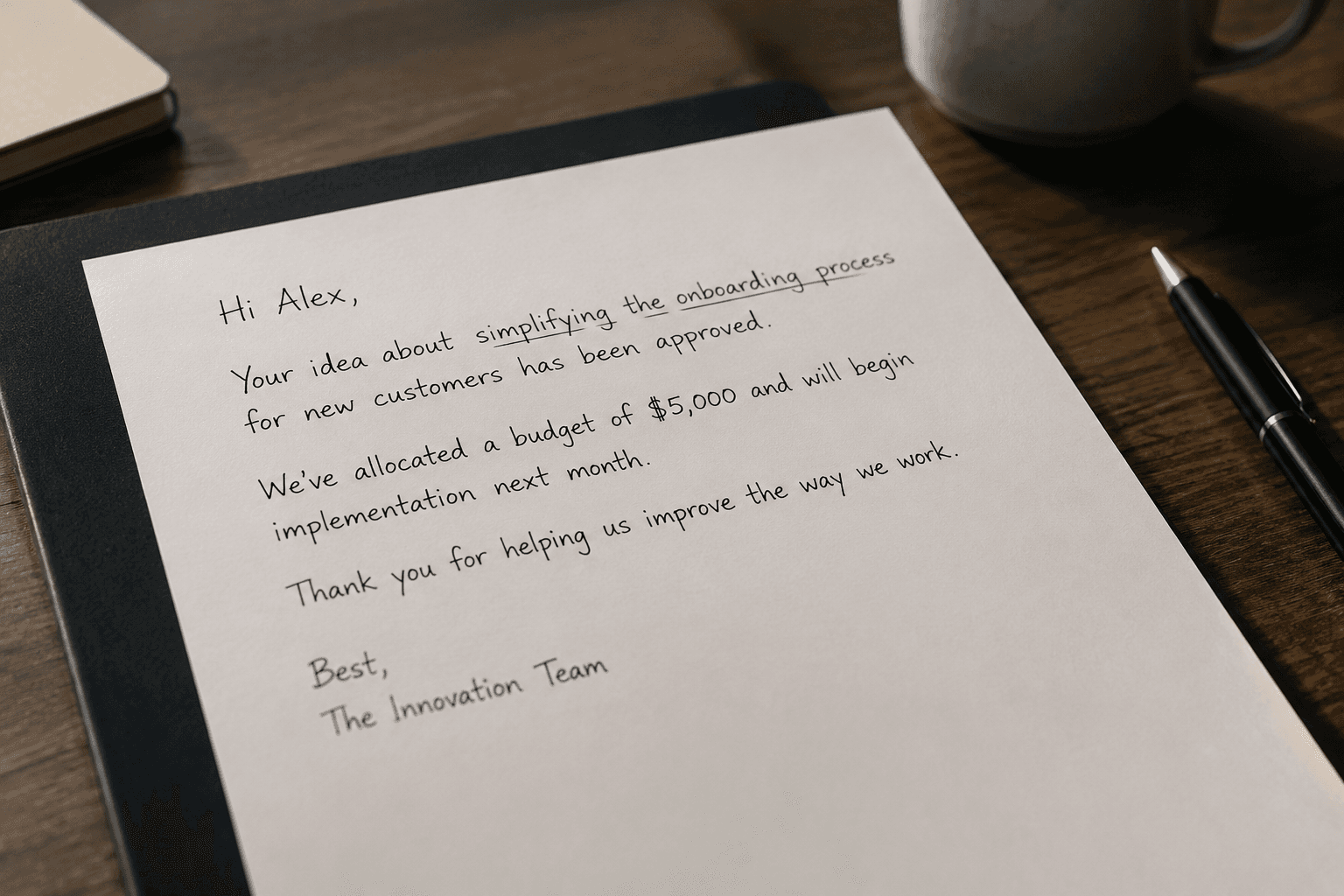
For approval:
Hi [name],

Your idea about [brief restatement] has been approved. We agree with your assessment of [the problem it solves]. The expected impact in our estimation is roughly aligned with your proposal.

Next steps: [owner] will lead the implementation, starting [date]. We expect [milestone] by [date].

We'll keep you in the loop. Thank you for raising this.
For decline (with reasoning):
Hi [name],

Your idea about [brief restatement] has been considered but won't move forward this quarter. The reason: [specific reason — usually one of (a) the impact is real but the cost or risk exceeds our current capacity, (b) we're already pursuing a similar approach through another route, (c) the timing doesn't fit our current operational priorities].

This is not a judgment of the idea. It's a judgment of fit, right now. If circumstances change [specific trigger that would re-open it], please resubmit.
For defer (with criteria for revisiting):
Hi [name],

Your idea about [brief restatement] has been deferred. We see the potential but need to see [specific dependency] resolve before we can commit. We'll revisit this in [timeframe], and you'll hear from us by then either way.
The templates take 90 seconds to fill in. They're harder to write than they look — the discipline of being specific is the work — but they're not complex.
Why companies don't do this
If the templates take 90 seconds and the cost of not doing this is high, why does almost nobody do it?
Four reasons, in order of how often they actually apply:
1. No named owner. "Someone should respond" means nobody responds. Without a person whose job it is to close the loop, the loop never closes.
2. Fear of saying no. Managers worry that declining an idea will damage the relationship. The opposite is true. Submitters can handle a "no" with reasoning. They cannot handle silence. The fear is misallocated.
3. Implicit "we'll get to it" culture. The idea sits in a backlog. The backlog is reviewed periodically. The periodic review skips ideas that are old, because the context has been lost. The ideas stay in the backlog until they're so old they're embarrassing to address.
4. Volume overwhelm. A company that received 200 ideas in their first quarter genuinely cannot respond to all of them with thoughtful feedback. The fix is to slow the front of the funnel (better submission criteria) rather than skip the back of it.
Each of these is solvable. None of them is automatic.
What changes when you commit
The companies that commit to answering every idea see three predictable changes over six to twelve months:
Submission quality improves. Employees know their submissions will be read carefully. They self-edit before submitting. Average quality rises.
Decision speed improves. Named owners under deadline pressure decide faster than committees with no deadline. Ideas that would have died in a backlog get to a yes or no in days, not months.
Cultural signal compounds. "Submissions get answered" becomes a known fact about the company. New employees experience this in their first six months. Trust in management compounds, not just on idea programs, but on adjacent topics like feedback, suggestions, and concerns.
The cost of all of this is bounded. The mandatory feedback loop adds 60-90 seconds per decision. For a company with 20 ideas per month, that's an hour of operations time per month.
How to start
If you're running an idea program today and the feedback loop is broken, three concrete steps:
1. Acknowledge the gap publicly. Send an email to the people who submitted ideas in the last 12 months. Apologize for the silence. Tell them you're addressing it. Be specific about how.
2. Name owners. One per category. Today. Not next quarter. Even if you don't have categories formalized, name the people who will respond. Their first job is to clear the backlog.
3. Set a 14-day response standard. From the day an idea is submitted, the submitter gets a response within 14 days. Even if the response is "we're still evaluating, here's where we are." Hold yourself to it.
If you're starting a new program from scratch, build the feedback loop in from day one. Make it impossible to submit an idea that doesn't get a response. The discipline at the start is much easier than re-installing it later.
The point
The phrase "every idea deserves an answer" is not a slogan. It's an operational commitment with a measurable cost (small) and a measurable benefit (large). Companies that make this commitment see their idea programs survive. Companies that don't see them collapse within 18 months.
The decision is not whether to respond. The decision is whether to run an idea program at all. If you're going to ask employees for their ideas, the implicit contract is that you'll tell them what happened. Breaking that contract is worse than never starting.
We built Sparqbox around this principle. Every idea reaches a decision. Every employee gets a written answer. The discipline is enforced by the software, because we found that without the enforcement, even well-intentioned operations leads couldn't keep it up.
The principle doesn't require our software. It requires the commitment. If you have the commitment, every idea will get answered. If you have our software, it'll be harder to break the commitment when things get busy.
Either way: every idea deserves an answer. Not because it's nice. Because the cost of silence is bigger than the cost of saying something true.